Archives

  • Creative Dilemmas and New Global Aesthetics: The Korean Wave on Digital Platforms
    No. 9 (2025)

    Korean popular culture (Hallyu) has evolved into a major force in global entertainment, challenging Western cultural dominance and achieving worldwide recognition through landmark successes such as Parasite, Squid Game, and recent achievements in film, television, and musical theater. This special issue situates the global rise of K-content within the structural conditions of platform capitalism and aesthetic capitalism, examining how digital platforms enable the rapid circulation and consumption of cultural difference as aesthetic value. Moving beyond audience-centered reception studies, the issue foregrounds production-side perspectives that remain underexplored in Hallyu scholarship. It brings together analyses of creative labor, studio systems, organizational cultures, and production strategies that shape Korean cultural content for global markets. By focusing on how K-content is produced, structured, and strategically positioned within contemporary digital media environments, this issue offers new insights into the sources of its sustained global appeal and competitiveness.

  • EU–Korea Cooperation in Climate Change Policies and Carbon Neutralization
    No. 8 (2025)

    This special issue of the Korea Europe Review brings together contributions that examine the economic, legal, and political dimensions of EU–Korea climate cooperation. The articles address the interplay between climate policy and trade governance, the prevention of carbon leakage through regulatory convergence, sectoral decarbonization challenges, and the role of middle powers in bridging divides between developed and developing countries. Collectively, they illustrate how cooperation can generate mutual gains while advancing the shared objective of carbon neutrality.

  • Interdisciplinary Insights and Innovations in East Asia-Europe Relations
    No. 7 (2025)

    This issue of the Korea Europe Review arrives amid global uncertainty, emphasizing the urgent need for diplomacy and strategic partnerships. Featured articles explore South Korea’s growing role in EU relations and its influence among middle powers. The issue also dives into East Asian security dynamics, including trilateral efforts with the U.S. and Japan, while proposing innovative frameworks for regional stability. Additionally, it highlights the impact of civil society and humanitarian diplomacy in promoting peace.


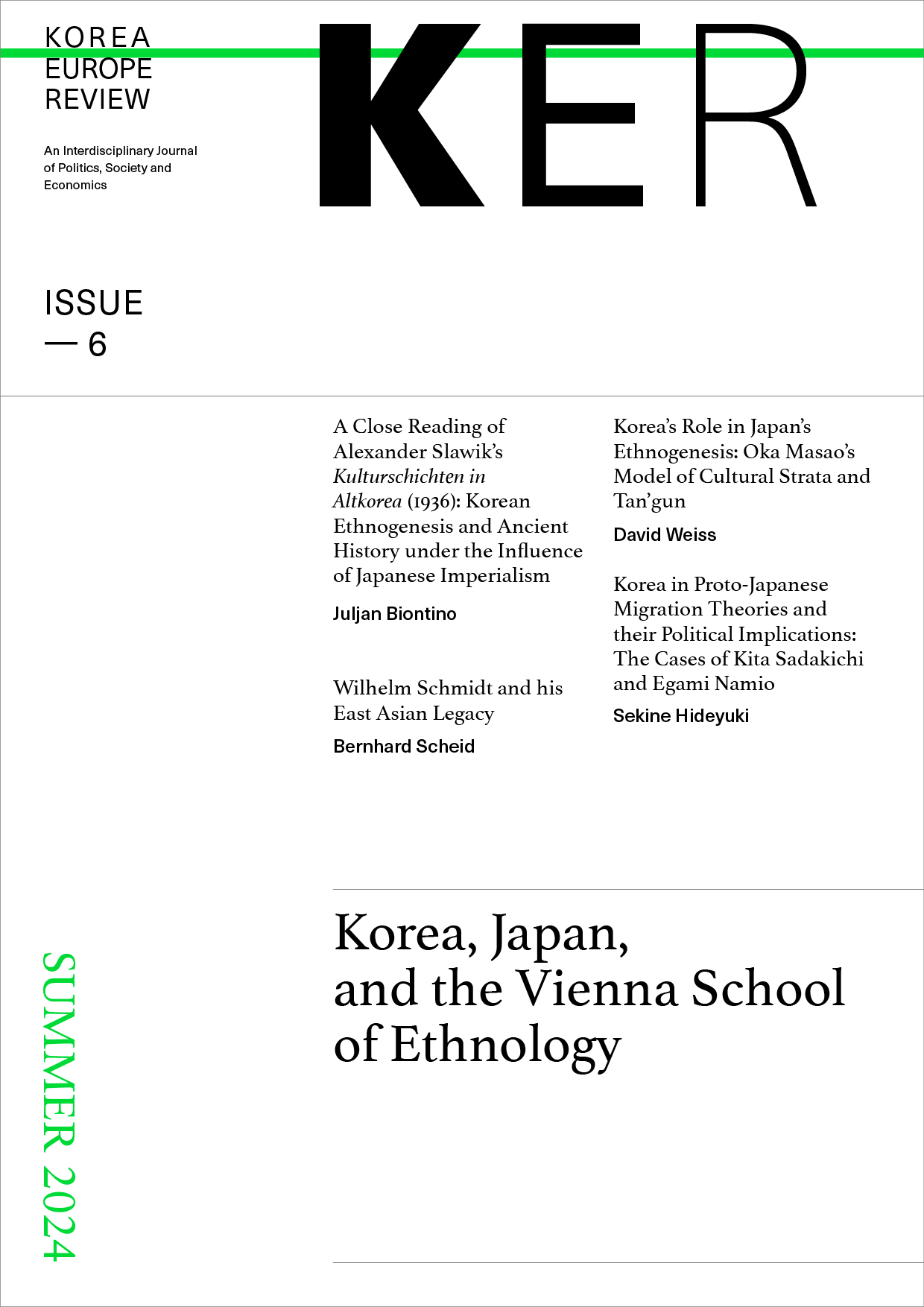
  • Korea, Japan, and the Vienna School of Ethnology
    No. 6 (2024)

    This issue examines the complex interplay between Japanese colonialism, the Vienna School of Ethnology, and the development of East Asian ethnology. KER presents a series of original articles exploring how Japanese scholars, influenced by the Vienna School’s methodologies, navigated the political landscape to shape discourse on Japanese-Korean ethnic relations. Through the works of figures like Wilhelm Schmidt, Oka Masao, and Alexander Slawik, the issue highlights how academic frameworks were adapted, sometimes to justify colonial ideologies and at other times to foster new understandings of cultural origins and ethnic identity.

  • Transnational Korea and the Korean Cinematic Imagination
    No. 3 (2022)

    “Transnational Korea and the Korean Cinematic Imagination” explores the theme of the transnational engagement, networks, connections, mobility, communities, diasporas and the cross-cultural flow of ideas between the Korean peninsula and other countries and regions across the globe with special emphasis on the role of Korean cinema.

  • Impossible Triangulation
    No. 2 (2022)

    The issue titled “Impossible Triangulation” seeks to explore the complex and increasingly multidimensional field of regional, international and global discourses, networks, alliances and power shifts afflicting the Korean peninsula. This includes the critical assessment of the possible future impact of these developments for the Korean peninsula but also for the larger (and indeed international) context of the so-called East Asian “security triangle”.